Address
Plot 100/487, Ibex Hill, Lusaka, Zambia
Work Hours
Monday to Friday: 7AM - 7PM
Weekend: 10AM - 5PM
Address
Plot 100/487, Ibex Hill, Lusaka, Zambia
Work Hours
Monday to Friday: 7AM - 7PM
Weekend: 10AM - 5PM

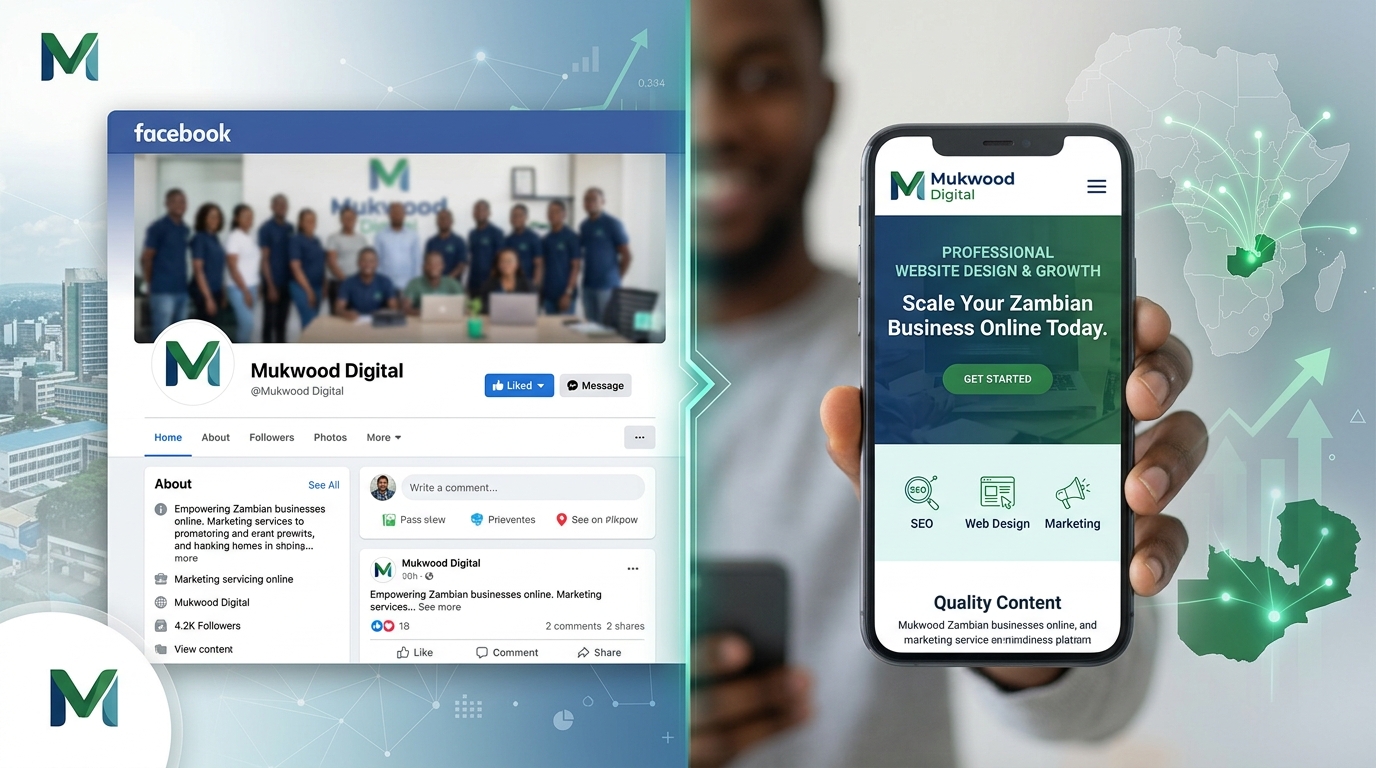
A Facebook page is not enough for your business in 2026. Discover why every Zambian SME needs a website — and how to get one from K600. Free consultation available.
Written by Mwenya Chongo — Web Developer & Digital Strategist, Mukwood Digital Last Updated: 23 May 2026 This article is based on verified industry research and data current as of May 2026.
You built a Facebook page. You post regularly. You have followers. So why aren’t the customers coming? This guide explains why a Facebook page is no longer enough for a Zambian small business in 2026 — and what you need instead.
Here’s a question worth sitting with: if your Facebook page disappeared tomorrow, would your business survive online?
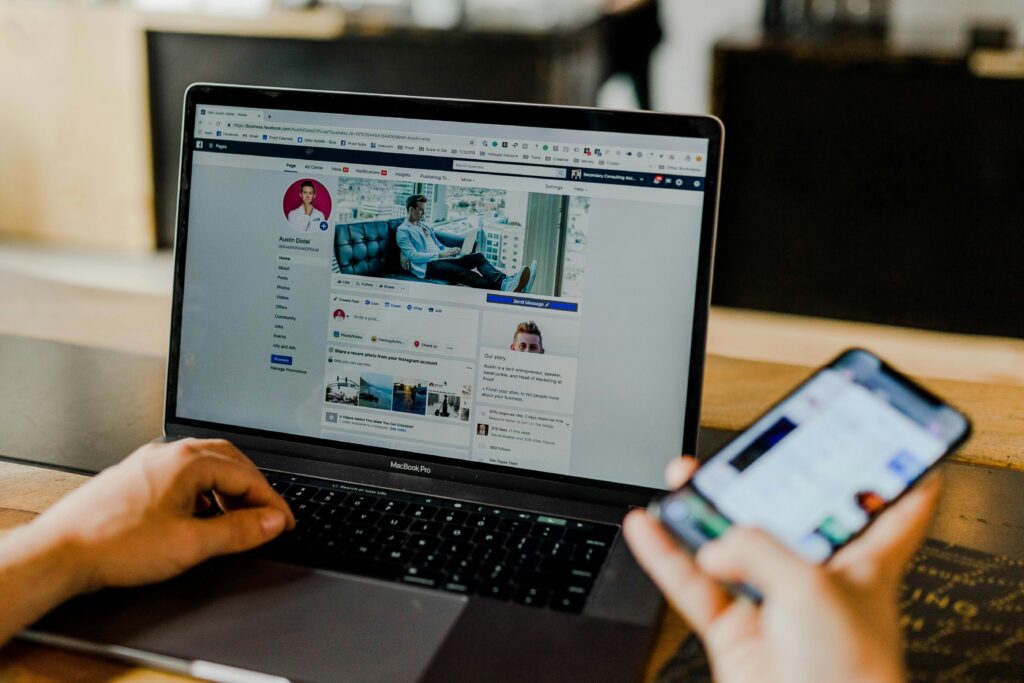
For most Zambian SMEs, the honest answer is no. And that’s a serious problem.
Thousands of small businesses across Zambia have built their entire online presence on a platform they don’t own, can’t control, and whose rules change without warning. Facebook is powerful — but it was never designed to be your business’s home on the internet. It was designed to keep people on Facebook.
According to Hootsuite’s 2025 research, Facebook’s organic reach for business pages has dropped to between 1–2%. That means if you have 1,000 followers, your posts are reaching 10–20 people. The rest? Facebook decides they don’t need to see it.
Mukwood Digital has worked with SMEs, NGOs, and startups across Zambia who faced this exact problem. This article explains why every Zambian small business needs a professional website in 2026 — and why your Facebook page, no matter how good it looks, cannot replace it.
Want to know what a professional website costs in Zambia? Jump straight to the section below or WhatsApp us for a free quote — 📱 +260 764 377 700
Facebook is still a useful tool. Let’s be clear about that. With over 3 billion monthly active users globally (Sprout Social, 2026), it’s one of the biggest platforms on the planet. In Zambia, Facebook remains one of the most widely used social media platforms for business discovery.
But using Facebook as your only online presence is like renting a market stall — and letting the market owner decide whether your customers can see you each day. Some days they can. Most days they can’t.
Here’s what the data shows about the real state of Facebook for businesses in 2026:
Back in 2012, Facebook’s average organic reach was a healthy 16% of your followers. By 2025, it had dropped to between 1–2%, according to Hootsuite research. That’s not a typo. If you have 5,000 Facebook followers, your posts now reach roughly 50–100 people organically.
The reason is simple. According to a 2025 analysis, Facebook’s algorithm now prioritises content from friends and family over business pages. Mark Zuckerberg announced this shift back in 2018, framing it as improving user experience. The reality is that Facebook is a business that needs to grow advertising revenue. The less reach your page gets for free, the more you need to pay to be seen.
Meanwhile, Verisign research found that 84% of consumers believe a business with a website is more credible than one with only a social media page. And Adobe research shows that 31% of shoppers have decided against buying from a small business simply because it had no website. For younger customers, that figure rises to 40%.
The gap between businesses with websites and businesses without is widening — fast.
This is the most important point in this entire article. Read it carefully.
Everything you post on Facebook — your photos, your reviews, your customer interactions, your content — belongs to a platform you have zero control over. Facebook can change its algorithm, restrict your reach, suspend your page, or shut down entirely. And you would have no recourse.
A website, on the other hand, is yours. You own the domain. You own the content. You control who sees what, how it’s presented, and what happens next. According to Showit’s 2026 research, “your website is the one place online you actually own — it’s what helps people find you, trust you, and take action.”
Bottom Line: Building your entire business on Facebook is building on rented land. A website is land you own.
When a potential customer types “plumber in Lusaka” or “catering services Zambia” into Google, they are not searching Facebook. They are searching the web. And Google’s results will prioritise websites — not Facebook pages.
According to DemandSage (2026), organic search generates 53% of all website traffic — making it the single largest source of visitors for any business online. Without a website, you are invisible to the majority of people who are actively searching for your products and services right now.
A Facebook page can appear in Google search results occasionally, but it will never rank the way a properly built, SEO-optimised website does. A website lets you target the exact keywords your customers are searching — “affordable web design Lusaka,” “events catering Zambia,” “women’s clothing store Lusaka” — and appear at the top of Google results for those searches.
Bottom Line: Google search is how most customers find businesses. Without a website, you cannot compete in that search.
💬 Not sure how to get your business found on Google? We can help. WhatsApp Mukwood Digital now for a free consultation — +260 764 377 700
Facebook is designed for engagement — likes, comments, and shares. It is not designed for conversions. A website is.
A professional website can include:
None of these are possible on a Facebook page with the same effectiveness. According to Network Solutions (2026), website and blog SEO remains the number one ROI-generating channel according to marketers — outperforming social media, email, and paid advertising.
When Mukwood Digital built the website for Nkonka Women in Agribusiness (NWAB), they went from having a Facebook page with limited membership management to a full digital platform with online registration, event management, and WhatsApp integration. The result was a professional presence that donors, partners, and government stakeholders could trust and engage with — something no Facebook page could have achieved.
[INTERNAL LINK: Portfolio Page]
Bottom Line: Facebook drives attention. A website drives conversions. Both are valuable — but only a website is built to turn visitors into paying customers.
Running a successful Facebook page in 2026 requires daily posts, video content, engagement responses, and — increasingly — paid advertising. The moment you stop posting, your reach drops. The moment you stop paying for ads, your visibility shrinks.
A well-built website, by contrast, works for you continuously. An SEO-optimised blog post written today can bring in new customers for years. A services page can rank on Google and generate enquiries while you sleep. Your portfolio speaks for you without you having to repost it every week.
According to a 2026 analysis by Addictive Digital, organic reach on social media has plummeted across almost every major platform — and the primary reason is that platforms are now designed to push businesses toward paid advertising. Facebook is no different.
A website is an investment that pays dividends over time. A Facebook page requires constant maintenance to deliver inconsistent results.
Bottom Line: A website works for your business 24 hours a day, 7 days a week — without requiring you to post fresh content every day just to stay visible.
A professional website is not just a digital brochure. In 2026, a well-built website is a complete business tool. Here is what it delivers that no Facebook page can match:
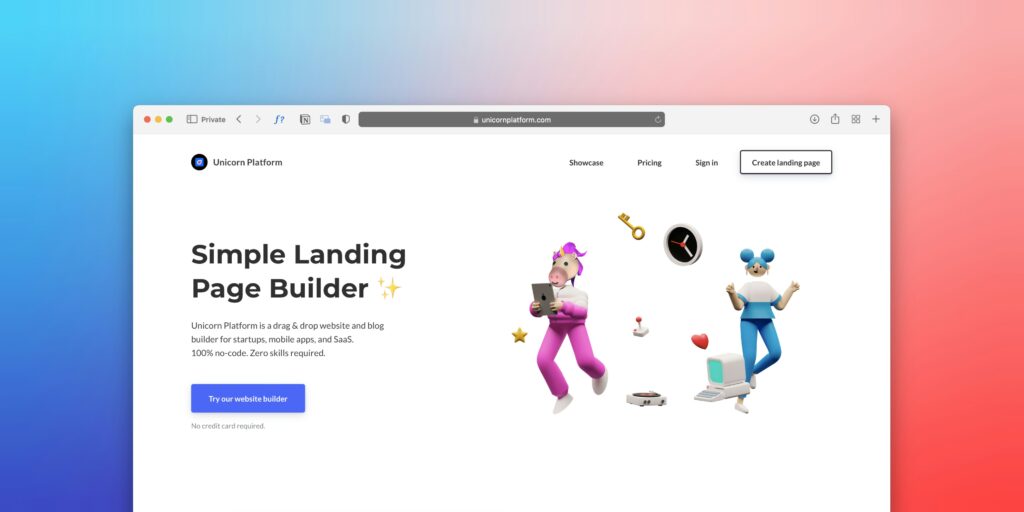
Your website works around the clock — taking enquiries, displaying your services, and building trust even when you’re asleep, in a meeting, or offline. Facebook requires you to be present and active to generate visibility.
On Facebook, your business looks like every other Facebook page — same layout, same fonts, same limitations. A website lets you present your brand exactly the way you want — your colours, your story, your design, your voice.
A website with good SEO can rank on Google for searches that bring in qualified, high-intent customers. These are people actively looking for what you sell — not passively scrolling a feed.
A website gives you clear data: how many people visited, which pages they read, where they came from, what they searched for, and where they dropped off. This data helps you understand your customers and improve your marketing. Facebook’s analytics are limited and controlled by Meta.
According to Verisign research, 84% of consumers believe a business with a website is more credible than one with only a social media page. In Zambia’s growing digital market, credibility is currency. A professional website signals that your business is serious, established, and trustworthy.
Objection 1: “My customers are on Facebook — that’s enough.” Your customers are on Facebook. But they’re also on Google, WhatsApp, and every other platform. When they’re ready to buy — not just scroll — they search Google. According to research, 63% of all shopping journeys begin with an online search (Think with Google, 2025). A Facebook page alone misses that entire journey.
Objection 2: “A website is too expensive for my small business.” Mukwood Digital builds professional websites starting from K600 — with free domain and hosting included for 12 months. That’s less than K50 per month for a business asset that works for you 24/7. The cost of not having a website — in lost credibility, missed Google traffic, and customers who don’t call — is far higher than K600.
Objection 3: “I don’t have time to manage a website.” A well-built WordPress website requires very little day-to-day management. Unlike Facebook, which demands daily posts to stay relevant, your website simply exists and works. Mukwood Digital also offers affordable monthly maintenance plans starting at K600/month that handle all updates, security, and backups for you.
Objection 4: “My business is too small to need a website.” No business is too small to benefit from being found on Google, looking credible to potential customers, and having a professional online presence. In fact, small businesses benefit most from websites — they level the playing field against larger, more established competitors.
Objection 5: “I’ll do it later when the business is bigger.” The businesses that are bigger in 2027 are building their websites now. Every month without a website is a month of Google ranking, credibility building, and customer trust that you cannot get back.
The Problem
Nkonka Women in Agribusiness (NWAB) — a Zambian NGO empowering women farmers — had a Facebook page and a basic online presence. But they had no way to register members online, manage events professionally, or present their work credibly to donors and government partners. Their Facebook page worked for community engagement but couldn’t carry the weight of a growing organisation.
The Solution
Mukwood Digital built NWAB a full WordPress website with an online membership registration system, an events management platform, and WhatsApp integration throughout. The site was mobile-responsive, SEO-optimised, and designed to communicate NWAB’s mission clearly to every visitor — whether a farmer in a rural area or a donor in an office.
The Result
NWAB now has a professional digital home that builds immediate credibility with partners, donors, and government stakeholders. Members can register online. Events can be promoted and managed through the site. And NWAB’s story is told professionally — in a way no Facebook page ever could.
Q: Does a small business in Zambia really need a website in 2026? A: Yes. A professional website gives your business credibility, Google visibility, and a 24/7 sales tool that no Facebook page can replace. According to Verisign research, 84% of consumers trust a business with a website more than one with only a social media page. In Zambia’s growing digital market, a website is no longer optional.
Q: Can’t I just use my Facebook page instead of a website? A: A Facebook page can support your business, but it cannot replace a website. Facebook’s organic reach has dropped to 1–2% for business pages (Hootsuite, 2025), meaning most of your followers never see your posts. You also don’t own your Facebook page — the platform controls your reach, your data, and your visibility.
Q: How much does a website cost in Zambia in 2026? A: Professional websites in Zambia start from K600 with Mukwood Digital, with free domain and hosting included for 12 months. Packages range from K600 for a basic starter site to K8,500 for a premium custom build with e-commerce. A free consultation helps you find the right package for your budget and goals.
Q: How does a website help my business get found on Google? A: A website built with SEO (Search Engine Optimisation) allows your business to appear in Google search results when potential customers search for what you offer. By targeting keywords relevant to your business — such as “catering services Lusaka” or “web design Zambia” — your website can bring in qualified customers who are actively searching for your services.
Q: What is the difference between a website and a Facebook page? A: A website is a platform you own and control, designed to convert visitors into customers through SEO, booking forms, product catalogues, and trust signals. A Facebook page is a social media profile on a platform owned by Meta, designed for engagement and discovery. Both are useful, but only a website serves as a permanent, owned digital asset for your business.
Q: How long does it take to build a website in Zambia? A: A basic website can be built and launched in 3–7 days. A professional custom website typically takes 10–21 days depending on the number of pages and features required. Mukwood Digital provides a clear timeline before any project begins.
Q: Do I need to update my website regularly? A: A well-built website requires minimal daily maintenance. Monthly updates, security patches, and occasional content updates keep it performing well. Mukwood Digital offers maintenance plans from K600/month that cover all of this, so you never have to worry about it.
Facebook is a discovery tool. A website is a conversion engine. You need both — but without a website, you’re missing the most important half of the equation.
Every day your business exists only on Facebook, you’re losing Google traffic, losing credibility with customers who expect a professional website, and handing an advantage to competitors who have one.
Mukwood Digital builds professional websites for Zambian SMEs, startups, and NGOs — starting from K600, with free domain and hosting for 12 months, WhatsApp integration, and a local support team that understands your market.
The best time to build your website was last year. The second best time is today.
Start with a free consultation — no pressure, no commitment.
📱 WhatsApp us: +260 764 377 700 ✉ info@mukwooddigital.com
Related Post — 5 Signs Your Website Is Losing You Customers